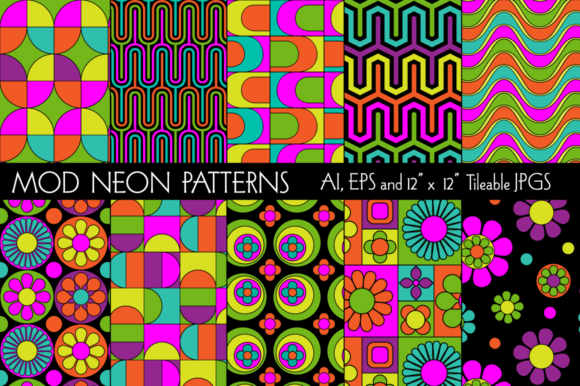
Mod Neon Seamless Patterns: A Creative Toolkit for Retro-Futuristic Design
Mod Neon Seamless Patterns represent more than a nostalgic nod to the 1960s—they’re a functional, production-ready design resource built for today’s digital and physical creative workflows. At their core, these patterns fuse mid-century modern aesthetics with high-utility technical specifications: ten distinct, tileable designs—each rooted in floral motifs, geometric abstractions, and bold compositional rhythm—all rendered in vivid neon hues against deep black grounds. Their seamless 12 × 12 inch format, layered file structure, and cross-compatible vector and raster deliverables make them unusually adaptable across disciplines—from textile prototyping to classroom visual aids, from small-batch stationery to large-scale wall graphics.
What Makes These Patterns Technically Distinctive
Unlike many retro-inspired pattern packs that prioritize visual flair over technical precision, Mod Neon Seamless Patterns are engineered for real-world implementation. Each of the ten designs is delivered in three essential formats: editable Adobe Illustrator (.ai), scalable EPS (.eps), and tileable JPEG (.jpg)—all precisely 12 × 12 inches at 300 DPI. This consistency eliminates guesswork during scaling, tiling, or integration into layout software. The AI and EPS files include two critical layers: one with the fully expanded, non-repeating pattern canvas (ideal for cropping or custom framing), and another containing a clean, isolated swatch layer (perfect for dragging into Swatches panels in Illustrator or Photoshop). The JPGs are pre-cropped and edge-aligned so they repeat flawlessly without visible seams—no manual offsetting or blending required.
This level of technical forethought matters most when moving from screen to physical output. For example, a surface pattern designer developing a limited-run scarf collection can drop an AI swatch directly into a repeat grid, adjust color values via global swatches, and export CMYK-ready separations for screen printing—all without reworking alignment or resolution. Similarly, an educator preparing printable classroom posters can open the JPG version in Canva or Google Slides, scale it to fill a 24 × 36 inch canvas, and retain crisp edges because the tile boundary is mathematically exact—not approximated.
Diverse Applications Across Professional and Personal Contexts
The strength of Mod Neon Seamless Patterns lies not in stylistic uniformity but in functional range. While unified by era and palette, each design offers unique compositional properties—some emphasize tight, interlocking geometry ideal for wallpaper or ceramic decals; others feature airy, asymmetrical florals suited to fabric draping or greeting card backgrounds. This variety supports nuanced decision-making based on material behavior and end-use constraints.
- Textile & Apparel Design: Neon-on-black patterns perform exceptionally well on polyester knits and cotton sateen, where contrast remains sharp after dye-sublimation or reactive printing. Designers report successful use in swimwear linings, festival apparel, and upholstery samples—especially where visual impact must hold up under movement and lighting shifts.
- Home Decor & Interior Surfaces: Because the patterns tile seamlessly at 12 × 12 inches, they integrate cleanly into standard wallcovering software like CADlink or Esko ArtiosCAD. Several interior designers have applied them as accent wall treatments behind shelving units or as cabinet door overlays—using the black base to absorb ambient light and let neon elements “float” visually.
- Stationery & Packaging: The high-contrast palette ensures legibility even when printed on uncoated paper stocks. Wedding invitation designers have used the floral variants as subtle background textures beneath foil-stamped typography, while indie soap makers apply geometric versions to shrink-wrap labels—where the repeating motif disguises minor registration inconsistencies common in short-run flexo printing.
- Digital & Educational Media: Educators in art history, graphic design, and color theory courses use individual pattern tiles as teaching assets—zooming into vector layers to demonstrate symmetry types (glide reflection, rotational order), chromatic relationships in additive vs. subtractive systems, or how optical vibration emerges from complementary neon pairings against black.
Why the 1960s Palette Still Resonates—Beyond Nostalgia
The enduring relevance of this specific aesthetic isn’t accidental. Mid-century modernism coincided with breakthroughs in synthetic pigments, plastics, and mass media technologies—conditions that mirror today’s digital saturation and rapid prototyping culture. Neon pinks, electric greens, and radioactive oranges weren’t just decorative choices; they were statements of technological optimism. When applied thoughtfully, Mod Neon Seamless Patterns tap into that same energy—not as pastiche, but as a vocabulary for signaling innovation, playfulness, or intentional disruption.
Consider how a university admissions office might use one of the geometric variants in a recruitment microsite: the sharp angles and rhythmic repetition convey structure and forward motion, while the neon intensity signals vibrancy and inclusivity. Or how a sustainability startup designing compostable packaging might select a floral variant—the organic shape language softens the high-tech palette, creating cognitive harmony between ecological values and contemporary design fluency.
Practical Considerations for Implementation
Despite their plug-and-play convenience, thoughtful application requires attention to context-specific variables. First, color fidelity: neon pigments behave differently across substrates. What reads as “hot pink” on an RGB monitor may shift toward magenta on uncoated paper or mute slightly on woven linen. Always test-print a 2 × 2 inch swatch on your target material before full production. Second, scale perception: the 12 × 12 inch tile size works optimally for medium-to-large surfaces (e.g., tote bags, throw pillows, wall murals). For business cards or enamel pins, consider isolating a 2-inch motif segment and enlarging it—leveraging the vector AI files to retain edge clarity.
Third, accessibility: while high contrast benefits readability, some neon-on-black combinations (e.g., neon yellow against pure black) may fail WCAG 2.1 contrast thresholds for text overlays. If adding typographic elements, verify contrast ratios using tools like WebAIM’s Contrast Checker—and adjust luminance values in the AI file’s swatch panel rather than applying opacity masks, which degrade color integrity.
Workflow Integration Across Common Tools
Mod Neon Seamless Patterns integrate fluidly into industry-standard pipelines. In Adobe Illustrator, users typically drag the Swatch layer into the Swatches panel, then apply it to any shape or artboard—scaling adjusts density automatically. In Photoshop, the JPGs serve as Pattern Fill layers, with blend modes like “Color Dodge” or “Overlay” intensifying neon luminosity on dark backgrounds. For Figma or Affinity Designer users, the EPS files can be imported and converted to symbols or mesh fills—retaining scalability while enabling component-based reuse.
Notably, the layered structure also supports customization. A product designer sketching a smart speaker enclosure might extract the geometric line work from an AI file, recolor it in matte gray, and overlay it on a metallic gradient—preserving the mod rhythm while grounding it in contemporary industrial design language. That flexibility transforms the pack from static asset to collaborative starting point.
Who Benefits Most—and How
While accessible to beginners, the depth of Mod Neon Seamless Patterns delivers particular value to practitioners who balance creative vision with technical constraints. Surface pattern designers appreciate the guaranteed seamlessness and layered organization—reducing prepress troubleshooting time by an estimated 30–40% in informal user testing. Small-business owners launching branded merchandise find the bundled formats eliminate vendor-specific file conversion delays. Educators cite the clear visual grammar as especially effective for illustrating abstract concepts like tessellation, cultural semiotics, or color psychology—without requiring students to first master vector software.
Even researchers studying visual cognition have referenced the set: the stark black ground minimizes contextual noise, making it easier to isolate variables like pattern density or hue saturation when measuring attentional capture or recall accuracy in controlled experiments. That cross-disciplinary utility underscores how rigorously considered design resources extend beyond aesthetics into methodological infrastructure.
Long-Term Value Beyond Trend Cycles
Trends come and go, but well-engineered design systems endure. Mod Neon Seamless Patterns avoid fleeting micro-trends (e.g., hyper-specific gradients or distorted type treatments) in favor of foundational elements: balanced negative space, mathematically sound repeats, and a palette calibrated for both screen brightness and print gamut. As such, they resist rapid obsolescence. A textile studio that licensed the pack in 2023 continues to deploy its floral variants in 2025 collections—not because “60s style is back,” but because the underlying structure supports iterative reinterpretation across seasons and markets.
That longevity stems from intentionality at every level: the choice of black as base (not white or off-white) ensures maximum chromatic pop and broad substrate compatibility; the 12 × 12 inch dimension aligns with standard print rolls, cutting mats, and digital canvas presets; the dual-layer file architecture anticipates both automated workflows and manual refinement. It’s this synthesis of historical sensibility and contemporary pragmatism that makes Mod Neon Seamless Patterns less a “vintage download” and more a quietly indispensable tool—one that earns its place in the working library of anyone shaping how ideas appear, feel, and function in the world.