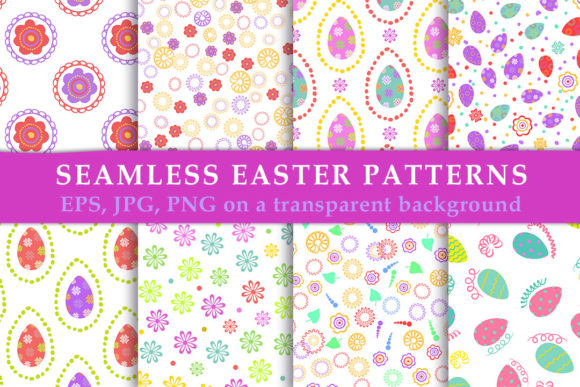
Seamless Easter Patterns
If you’ve ever spent hours trying to tile a digital Easter design—only to spot that awkward seam where the pattern repeats—you know how frustrating it can be to find truly seamless options. Seamless Easter Patterns solve that exact problem: they’re thoughtfully designed, edge-to-edge compatible graphics that repeat flawlessly across any surface, whether you're printing a 24-inch scrapbook page or covering an entire event backdrop.
What Makes These Patterns Truly Seamless—and Why It Matters
“Seamless” isn’t just marketing speak here—it means every pixel at the top aligns perfectly with the bottom, and every edge on the left matches the right. No visible breaks. No ghost lines. No last-minute Photoshop patching. That precision is baked in from the start, using vector-first workflows and rigorous raster testing at full 4000×4000 px resolution.
This level of alignment matters most when scale changes. Imagine wrapping a tall gift box with a pastel bunny motif: if the pattern isn’t truly seamless, you’ll see misaligned ears or clipped eggs every time the design repeats. With these patterns, your wrap looks hand-finished—not digitally tiled.
Real-Life Uses You’ll Reach For Again and Again
These aren’t just “nice-to-have” digital assets—they’re quietly essential tools for people who make things with intention. Here’s where they show up in everyday creative work:
- Scrapbookers use the PNG files (transparent background) to layer Easter motifs over photos—think bunnies peeking from behind a child’s spring portrait or delicate egg silhouettes fading softly into journaling blocks. The transparency means no white boxes marring your composition.
- Small-batch crafters print the JPG versions (white background, 300 dpi) directly onto kraft paper or matte cardstock for custom gift tags, envelope liners, or DIY Easter cards. Because it’s high-res and white-based, colors stay true without needing extra masking or background removal.
- Event designers and educators rely on the EPS10 vector files when scaling up. Need that same carrot-and-egg pattern stretched across a 6×8 ft classroom bulletin board? Or resized down to 1.5 inches for a vinyl-cut classroom sticker? The vector holds crisp detail at any size—no pixelation, no reworking.
- Print-on-demand creators integrate these patterns into fabric mockups, mug templates, or planner covers. The seamless nature ensures consistency across product variations—so your Easter-themed notebook line feels cohesive, not pieced together.
Who Benefits Most—and How Their Needs Shape Use
A homeschool parent planning a spring unit might download one pattern to print as a reusable learning mat—bunnies and chicks spaced evenly for counting games. They’ll choose the JPG version because it prints cleanly on standard home printers, and the white background keeps text legible when laminated.
A professional stationery designer, meanwhile, will open the EPS file in Illustrator to recolor the palette to match a client’s brand—swapping mint for sage, gold foil accents for soft peach—then export swatches for packaging mockups. They need scalability and color flexibility, not convenience alone.
Even hobbyist bakers use these: one customer shared how she printed the PNG pattern onto edible wafer paper (using a compatible inkjet printer), then cut out egg-shaped toppers for cupcakes—transparency meant no white edges around each shape, giving her treats a polished, boutique look.
Practical Things to Keep in Mind Before You Start
First—check your software compatibility. While PNG and JPG files open anywhere, the EPS10 vector requires Adobe Illustrator (CS6 or newer) or Affinity Designer for full editing control. Free vector editors like Inkscape may import it, but complex gradients or transparency layers could shift slightly.
Second—consider your output method. If you’re laser-printing on dark cardstock, the white-background JPG won’t work well (that white area will show). In that case, the transparent PNG gives you full control to drop the pattern over any base color—or invert it in editing software before printing.
Third—mind the repeat scale. All patterns are built on a 4000×4000 px tile, which gives generous room to zoom without losing fidelity. But if you’re designing for very fine-detail applications—like embroidery digitizing or micro-printed textile labels—you may want to test a small section first. While vector-based, some hand-drawn elements (like watercolor-style egg textures) have intentional grain that reads beautifully at 8–12 inch prints but softens under extreme magnification.
Strengths That Stand Out in Daily Use
These Seamless Easter Patterns shine where others fall short: consistency across formats, thoughtful color palettes (soft but printable, pastel but not washed-out), and real-world testing. Each pattern was proofed by printing full 11×17″ sheets, checking seam alignment both visually and with digital overlays. No “almost-there” repeats.
The inclusion of three distinct formats—PNG, JPG, and EPS—means you’re not forced into workarounds. You don’t need to remove backgrounds manually, resample low-res downloads, or pay extra for vector upgrades. It’s all there, ready.
A Few Gentle Limitations to Acknowledge
Because these are seasonal, curated patterns—not algorithmically generated—the collection focuses on timeless Easter motifs: speckled eggs, woven baskets, sprigs of hyacinth, minimalist bunnies, and gentle florals. You won’t find cartoon characters, licensed icons, or ultra-modern geometric interpretations. That’s intentional: this set is built for warmth, tradition, and tactile craft—not trend-chasing.
Also, while the EPS files are fully editable, they’re not layered by object type (e.g., “all eggs on one layer, all grass on another”). Instead, they’re grouped logically by visual rhythm—so a basket pattern keeps handle and weave unified, making recoloring intuitive but not hyper-granular. That balance keeps files lightweight and stable across platforms.
Where These Patterns Fit Into Your Creative Flow
Think of them less as standalone graphics and more as quiet collaborators. They’re the consistent thread in your Easter projects—whether you’re prepping five dozen classroom treat bags or designing a limited-run fabric collection for a local boutique. They save time not by doing the work for you, but by removing friction: no hunting for matching repeats, no guessing at resolution limits, no second-guessing print safety.
One teacher told us she uses the same carrot-and-tulip pattern across four different classroom resources—name tags, behavior charts, reading logs, and a hallway banner—because the cohesion helps her students instantly recognize the theme. Another small-business owner uses the egg-and-linen pattern as her Instagram story template background, changing only the text each week. Consistency, without repetition fatigue.
Thank you for visiting my store. Svetlana.