Line Art Patterns with Poppy Flowers
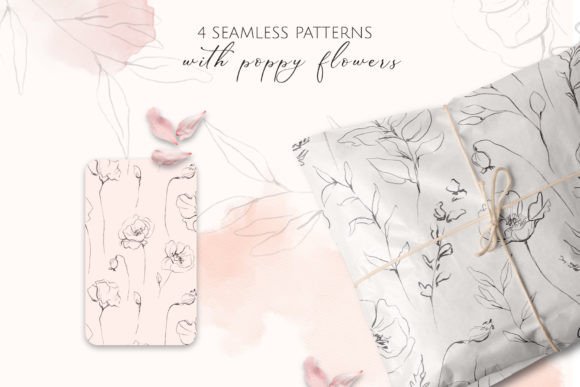
Delicate, hand-drawn poppies rendered in clean, expressive line art—each petal and stem captured with quiet precision. These aren’t mass-produced vector motifs or AI-generated approximations. They’re authentic pencil sketches transformed into seamless, high-resolution patterns: soft yet confident, minimal yet full of character. The collection includes four distinct arrangements—some featuring single stems drifting across the canvas, others weaving clusters of blossoms into gentle rhythm. All files are delivered as PNGs with transparent backgrounds and 300dpi resolution, ready for both digital and print use.
Why this matters—depending on who you are
If you’re designing wedding stationery, a single line-art poppy pattern can anchor an entire aesthetic: elegant but unstuffy, romantic without being saccharine. A couple choosing rustic-chic invitations might layer the pattern subtly behind handwritten calligraphy—or use it as a border on save-the-dates and menus. Because the lines are fine and the composition airy, it scales beautifully—from tiny thank-you card corners to full-page envelope liners.
For social media creators—especially those in lifestyle, botanical illustration, or mindful living niches—these patterns offer texture without visual noise. Try overlaying one at 15% opacity on a flat-lay photo of coffee and journaling supplies. Or use it as a consistent background element across Instagram story highlights, giving your feed cohesion without demanding attention. No need to license stock graphics or wrestle with clipping masks—the transparency means it drops in cleanly.
Small business owners producing artisan wrapping paper, greeting cards, or fabric-based goods will appreciate how these patterns behave in repeat. Seamless means no visible tile edges when printed on rolls or large sheets. And because they’re rooted in real pencil work—not algorithmic symmetry—they retain warmth and variation. That subtle irregularity reads as human-made, which aligns with values-driven branding around authenticity and craft.
How skill level shapes what you notice—and need
Beginners often prioritize ease of use first. You don’t need design software expertise to benefit from these files. Drag a PNG into Canva, resize it, and apply it as a background. Adjust opacity, rotate slightly for visual interest, or use it as a watermark behind text. There’s no learning curve tied to vector paths, layers, or color modes—just clarity, simplicity, and immediate results.
More experienced designers may zoom in—not to fix flaws, but to study intention. Notice how the line weight shifts ever so slightly where a stem bends, or how each poppy’s center is suggested with three quick strokes rather than filled detail. That kind of nuance supports higher-end applications: letterpress printing, foil-stamped stationery, or textile screen printing where line integrity directly affects output fidelity. The 300dpi resolution ensures crispness even under magnification or tight crop.
Educators teaching visual communication or surface pattern design might use these files as teaching tools—not just as assets, but as examples of intentional minimalism. How does reducing a flower to essential lines preserve its identity? What decisions support seamlessness while keeping the motif legible at small scale? Students can deconstruct the repeats, trace motifs by hand, or experiment with recoloring using layer blending modes—all grounded in real-world reference.
What different priorities reveal about fit
- Flexibility: Each pattern works equally well in light-on-dark or dark-on-light contexts thanks to the transparent background. You’re not locked into preset colors or fixed layouts—just raw, adaptable linework.
- Presentation value: Whether used on a boutique website banner or a printed product label, the patterns communicate care and curation. They suggest thoughtfulness—not just decoration.
- Commercial reliability: PNG format avoids font or embedding issues common with vector files. No missing elements, no rendering inconsistencies across devices or platforms. What you see is what prints—and what displays.
- Creative longevity: Unlike trend-heavy graphics that date quickly, botanical line art has enduring resonance. Poppies carry layered symbolism—remembrance, resilience, peace—making them meaningful across seasons and contexts.
Real projects, real choices
A freelance illustrator building a brand kit for a new herbal apothecary chose one of the patterns as a subtle watermark behind service descriptions on her website. It reinforced botanical credibility without competing with photography.
A teacher creating printable mindfulness journals used the same pattern as a header for weekly reflection pages—soft enough to soothe, structured enough to ground.
A stationery startup testing low-minimum runs ordered fabric swatches printed with one of the patterns. The fine lines held up across cotton, linen, and recycled paper blends—confirming versatility before committing to bulk production.
None of these users needed complex licensing terms or multi-format bundles. They needed something true to hand-drawn origin, technically sound for output, and quietly evocative in effect.
Does this match your next step?
If you’re weighing whether Line Art Patterns with Poppy Flowers fits your current project, ask yourself:
- Do I want botanical imagery that feels personal—not generic?
- Am I working across formats (digital + print) and need consistency without compromise?
- Is transparency and resolution non-negotiable for my output method?
- Do I value subtle storytelling—where a single flower speaks to memory, transition, or quiet beauty?
It won’t replace custom illustration for highly branded campaigns. It won’t suit users needing editable vectors for extensive recoloring or distortion. But if you seek authenticity, adaptability, and quiet elegance—delivered simply and respectfully—this collection meets that need precisely.
Questions? Reach out—you’ll hear back from Yuliia directly. No automated replies, no vague timelines. Just thoughtful support for thoughtful work.