Forest Animals Watercolor Patterns: A Practical Guide for Designers and Crafters
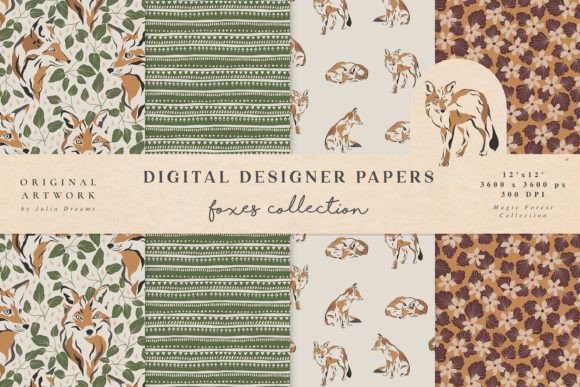
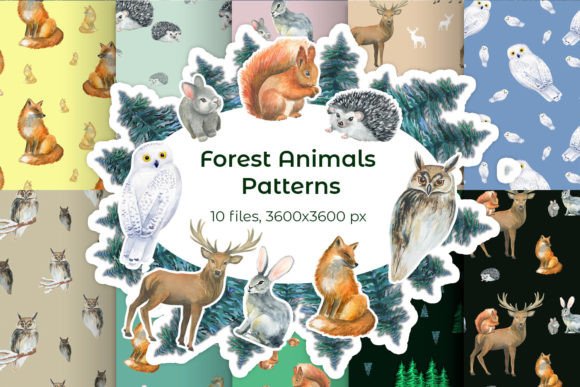
Forest Animals Watercolor Patterns refer to a curated digital collection of seamless, hand-painted motifs featuring foxes, hedgehogs, squirrels, hares, owls, and deer—rendered in soft, naturalistic watercolor textures. These patterns are not clipart or vector illustrations; they’re high-resolution raster files designed for real-world application across physical and print-based projects. Each pattern repeats smoothly without visible seams, making them suitable for large-scale surfaces like wallpaper, fabric yardage, or garment panels.
What Sets These Patterns Apart from Other Nature-Inspired Designs
Unlike generative AI outputs or mass-produced stock motifs, Forest Animals Watercolor Patterns emphasize organic imperfection—the subtle bleed of pigment, the gentle granulation of watercolor paper, and the variation in line weight and tone that comes from traditional media. This gives them a tactile authenticity often missing in digitally uniform alternatives. The animals are stylized with warmth and charm but avoid exaggerated cuteness that can feel infantilizing; instead, they balance whimsy with quiet realism—ideal for spaces where sophistication and child-friendliness coexist.
Compared to botanical-only watercolor patterns, this set introduces narrative depth through animal characters. A fox curled mid-leap or an owl perched thoughtfully adds gentle storytelling—something that resonates more strongly in children’s environments than static leaf or mushroom motifs alone. Yet the palette remains grounded: muted moss greens, warm ochres, slate greys, and creamy off-whites—designed to age well and layer easily with existing décor.
How They Compare Across Common Use Cases
When evaluating Forest Animals Watercolor Patterns against other design resources, context matters most. Here’s how they align—or diverge—with typical alternatives:
- For wall decor in children’s rooms: Seamless watercolor patterns offer a softer, more breathable alternative to bold cartoon prints or photographic murals. Unlike vinyl decals (which require precise installation and may peel over time), these patterns can be printed on removable wallpaper or non-woven substrates—giving flexibility for future redecorating. They also avoid the visual “busyness” of tightly packed character scenes, allowing breathing room for furniture and toys.
- For home textiles: At 3600×3600 px and 300 dpi, each JPEG is sized to scale reliably across standard fabric widths (e.g., 54" or 140 cm). That resolution supports sharp printing on cotton, linen, or polyester blends—unlike lower-res downloads that blur when enlarged. However, they are not editable vector files, so custom color shifts or element repositioning require raster editing skills (e.g., Photoshop or Affinity Photo).
- For children’s clothing: The gentle scale and balanced density of these patterns reduce visual overwhelm—a practical advantage over oversized animal graphics that dominate small garments. Because the motifs repeat evenly, seam allowances and pattern matching stay predictable during sewing. Still, designers should test print-on-demand services first: some platforms compress JPEGs or alter color profiles, potentially muting the watercolor subtlety.
Strengths and Realistic Tradeoffs
The primary strength of Forest Animals Watercolor Patterns lies in their intentional cohesion. All ten designs share consistent lighting, texture behavior, and chromatic harmony—meaning you can mix and match within a single project without clashing. That’s rare among marketplace bundles, where patterns are often assembled from disparate sources.
Yet there are tradeoffs worth noting. As JPEGs—not PSDs, PNGs with transparency, or vectors—they lack layered elements or alpha channels. You cannot isolate a single squirrel to use independently, nor adjust individual motif opacity without affecting the entire tile. If your workflow relies heavily on modular customization (e.g., swapping one animal for another), this format will require extra effort.
Also, while the resolution suits most print applications, it’s not ideal for ultra-large-format output (e.g., building wraps or exhibition banners exceeding 6 feet wide), where vector-based scalability becomes essential. And because the set focuses exclusively on forest dwellers, it doesn’t include companion elements like mushrooms, ferns, or tree silhouettes—so pairing with complementary botanical patterns may be necessary for richer visual layering.
When This Set Fits—and When It Might Not
Forest Animals Watercolor Patterns are especially well-suited for makers who prioritize aesthetic continuity, work with print-on-demand textile services, or design for early childhood education settings where calm, nature-based visuals support emotional regulation. Interior designers selecting wallpaper for pediatric clinics, Montessori classrooms, or family-friendly cafes often find these patterns strike a thoughtful middle ground between playful and serene.
They’re also practical for small-batch crafters producing limited-run baby blankets, nursery curtains, or handmade stationery—where consistency across product lines matters, and licensing clarity is essential (this set appears intended for commercial use, though users should always verify license terms before resale).
That said, if your project requires monochrome versions, high-contrast variants for accessibility, or SVG exports for Cricut/Silhouette cutting machines, this bundle won’t meet those needs out of the box. Similarly, educators or therapists looking for labeled, educational animal illustrations (with names, habitats, or anatomical features) will need supplemental resources—these patterns celebrate atmosphere over instruction.
Practical Tips for Getting the Most From the Files
Before printing or production, consider these realistic steps:
- Soft-proof colors: Open a sample JPEG in your editing software and compare its appearance under sRGB and CMYK profiles. Watercolor textures can shift noticeably between screen and print—especially blues and greys—so request a physical proof from your printer if color accuracy is critical.
- Test scale on fabric: Print a 12×12 inch swatch on your intended textile type. Watercolor grain behaves differently on slubbed linen versus smooth cotton poplin—what reads as delicate on screen may appear muddied on certain weaves.
- Check repeat behavior: Load one pattern into a tiling tool (like Adobe Illustrator’s Pattern Options or free web tools such as Patterninja) to confirm seamless alignment. While the set is described as seamless, minor edge artifacts can occur depending on software interpolation.
- Plan for bleed and trim: For wallpaper or quilt backing, extend the canvas by at least 0.5 inches beyond the tile boundary to accommodate trimming variance—JPEGs don’t embed crop marks or registration guides.
Making an Informed Choice Among Nature-Themed Resources
Choosing between Forest Animals Watercolor Patterns and other nature-inspired assets ultimately depends on your goals, technical capacity, and end medium. Vector animal packs offer more flexibility for scaling and recoloring—but often sacrifice textural nuance. Hand-drawn Procreate brushes let you build custom scenes, yet demand time and skill to achieve cohesive repetition. AI-generated pattern tools produce fast variations but rarely deliver the same tonal consistency or intentional composition.
What makes Forest Animals Watercolor Patterns stand out isn’t novelty—it’s reliability. Ten coordinated, production-ready files, delivered in a single ZIP, eliminate the friction of sourcing, color-matching, and resolution-checking across multiple vendors. For someone balancing creative vision with tight timelines—or working across disciplines like interior design, textile development, and early learning environments—that consistency has measurable value.
If your priority is expressive, printable, emotionally grounded design that supports both imagination and calm—without requiring advanced technical adaptation—then Forest Animals Watercolor Patterns offer a focused, well-executed option. Just remember: the best pattern isn’t the one with the most animals, but the one that works seamlessly within your process, materials, and purpose.