Cute Hand Drawn Seamless Patterns
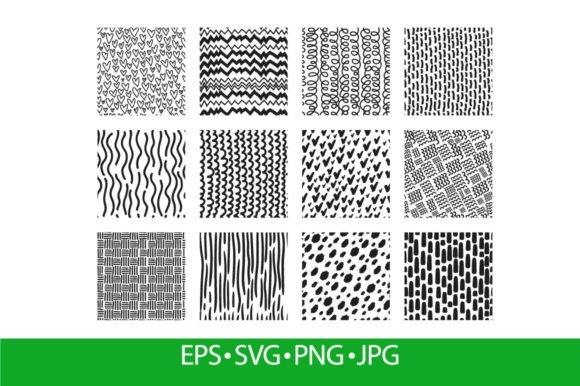
Imagine opening a digital folder and finding dozens of playful, hand-sketched motifs—tiny hearts, wobbly waves, joyful scribbles, and soft monochrome swirls—that tile perfectly edge-to-edge. No gaps. No awkward seams. Just effortless repetition that feels warm, human, and full of quiet charm. That’s the essence of Cute Hand Drawn Seamless Patterns: not sterile vector repeats, but intentionally imperfect, ink-on-paper–style textures designed to breathe life into flat surfaces.
Where These Patterns Actually Show Up in Real Life
You’ve probably seen them—and loved them—without even knowing their name. A ceramic mug with tiny looping scribbles around the handle. The lining of a handmade tote bag covered in scattered dots and gentle curves. A greeting card where delicate hand-drawn stripes frame the message like a cozy border. These aren’t accidents. They’re deliberate choices made possible by Cute Hand Drawn Seamless Patterns.
Small-batch makers use them to design fabric for baby rompers or linen napkins—patterns that feel personal, not mass-produced. Stationery designers layer them behind handwritten quotes or use them as subtle backgrounds in printable planners. Even interior designers pull these into mood boards when sourcing wallpaper for nurseries or boutique cafes aiming for “thoughtful minimalism.” One illustrator told us she uses the dot-and-wave combos as texture overlays in Procreate—just 15% opacity—to soften digital illustrations without losing sketchbook authenticity.
Who Gets the Most Out of These Patterns (and Why)
Indie crafters and Etsy sellers rely on them because they bridge the gap between handmade appeal and scalable production. You can’t hand-paint 200 fabric panels—but you *can* print a seamless pattern across yardage and still keep that artisanal warmth. A seamstress in Portland shared how she paired simple monochrome swirls with organic cotton twill to create matching aprons and tea towels for a local bakery launch. Customers kept commenting on how “friendly” and “unfussy” the designs felt—exactly the vibe she wanted.
Digital product creators (think Notion template designers, Canva creators, or printable journal makers) use these patterns as low-key visual anchors. A set of clean line doodles in SVG format becomes the subtle header divider in a habit tracker. Wavy scribbles in PNG, at 300 DPI, turn into watermark textures for digital art prints—soft enough to recede, distinctive enough to brand.
Teachers, therapists, and wellness practitioners quietly lean on them too. One occupational therapist uses heart-and-line combos printed on cardstock for fine-motor tracing exercises with kids. Another created laminated “calm-down cards” featuring gentle swirls and dots—no words needed, just soothing rhythm and familiarity.
Formats Matter More Than You Think
These patterns come in EPS, SVG, PNG, and JPEG—but each serves a different purpose, and mixing them up can save (or cost) you real time.
- EPS and SVG are your go-to for scalability: resizing a stripe pattern for a 10-foot banner or shrinking it down for a button badge won’t blur or pixelate a thing. Ideal for textile printers, laser cutters, or Cricut users.
- PNG files with transparent backgrounds are perfect for digital overlays—adding a whisper of texture to a website hero image, or dropping a scribble repeat behind text in a social media post.
- JPEGs work well for quick mockups, email newsletters, or platforms that don’t support transparency. Just remember: they’re fixed-resolution. Enlarge too far, and edges get fuzzy.
A note on color: most Cute Hand Drawn Seamless Patterns sets start monochrome (black/white/grays), making them endlessly adaptable. You can recolor swirls in Illustrator to match your brand palette—or leave them raw for that classic pencil-and-ink look. Some designers even invert them: printing white scribbles on navy fabric for high-contrast texture that still feels soft.
What to Consider Before You Download or Buy
Not all “seamless” patterns tile as smoothly as advertised. Always test before committing:
- Zoom in on the tile boundary—look for visible lines, mismatched strokes, or abrupt cutoffs where the pattern restarts.
- Tile it yourself in Photoshop or Figma: duplicate the pattern four times in a grid and check corners. Does the wave flow naturally from top to bottom *and* left to right?
- Check scale. A tiny dot repeat might vanish on upholstery fabric but sing on a phone case. Many sets include multiple sizes—small, medium, large—so you’re not stuck scaling and distorting.
Also consider licensing. If you’re selling physical products (like scarves or enamel pins), make sure the license permits commercial use—and whether attribution is required. Reputable pattern bundles clearly state this upfront. One designer avoided a legal hiccup by double-checking: her favorite scribble set allowed unlimited physical goods but restricted resale of the raw files as standalone assets.
When Simplicity Is the Secret Strength
There’s power in restraint. Unlike photorealistic or hyper-detailed repeats, Cute Hand Drawn Seamless Patterns thrive on simplicity—wobbly lines, uneven spacing, slight variations in stroke weight. That’s not a flaw; it’s the feature. It signals approachability. It invites touch. It says, “This was made with care, not algorithms.”
That same simplicity makes them unusually versatile. A set of minimalist hearts and dashes works equally well on a yoga studio’s website background, a pediatric dentist’s waiting room mural, or the packaging for a small-batch honey brand. No stylistic whiplash. No overcomplication. Just quiet consistency with personality.
A Few Quiet Limitations to Keep in Mind
They’re not magic. If you need photorealistic florals or ultra-precise geometric precision, these won’t fit. And while their charm lies in imperfection, that means they’re less suited for contexts demanding clinical sharpness—think technical manuals or medical device interfaces.
Also, true hand-drawn texture doesn’t always translate cleanly to every material. A fine scribble repeat may disappear on coarse burlap or get lost in embroidery stitch density. Test on your intended substrate first—especially if you’re screen-printing or sublimating.
Finally, avoid overloading. One user shared how she initially tiled a busy wave-and-dot combo across an entire notebook cover—only to realize it fatigued the eye. Switching to a single band of the same pattern along the spine kept the charm but added breathing room. Sometimes less repeat is more resonance.
How to Start Using Them Without Overthinking
Pick one pattern that makes you pause—not because it’s flashy, but because it feels like a quiet “yes.” Try it in a low-stakes place first: as a border in a Google Doc header, as a background layer in a Canva social post, or printed on scrap paper to see how it holds up next to your favorite pen.
Notice how it changes the tone. Does the scribble repeat make your to-do list feel lighter? Does the monochrome swirl add calm to a presentation slide? That’s not decoration—it’s emotional scaffolding. And that’s why Cute Hand Drawn Seamless Patterns keep showing up, quietly and meaningfully, wherever people want to make something feel human first.