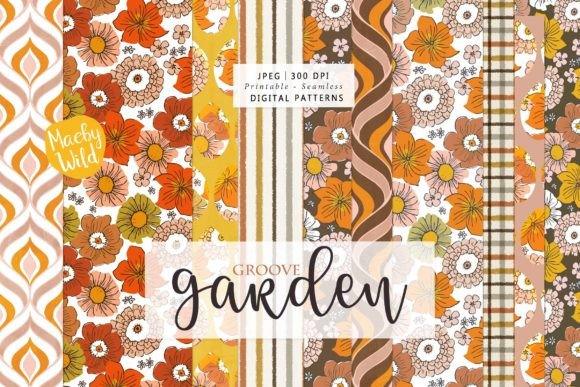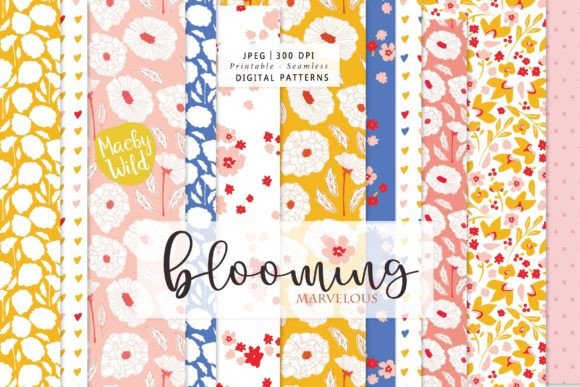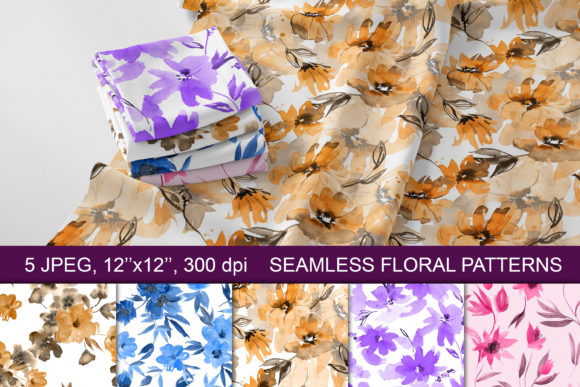
Blooming Garden Floral Patterns
If you’ve ever stared at a blank canvas—whether it’s a digital design file, a plain tote bag, or a wall waiting for personality—you know how much time and energy goes into finding the *right* floral motif. Not too busy. Not too sparse. Warm, organic, and unmistakably hand-crafted. That’s where Blooming Garden Floral Patterns steps in—not as another generic clipart pack, but as a thoughtfully curated set of watercolor florals that behave like real paint on paper: soft edges, gentle pigment variation, and subtle texture you can feel even on screen.
What You’re Actually Getting (and Why It Matters)
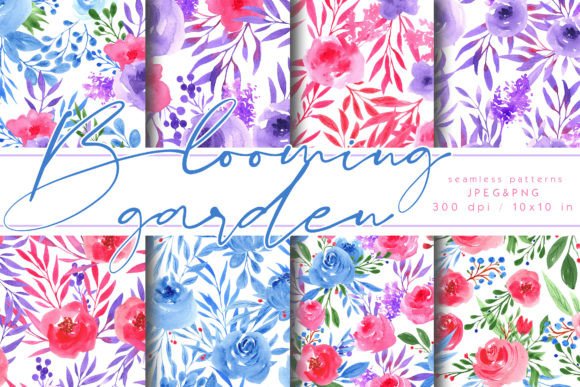
This isn’t just “8 floral patterns.” It’s 16 high-resolution files—8 JPEGs with soft neutral base tones (think warm ivory, dusty rose, sage, and muted sky blue), and 8 matching PNGs with full transparency. Each is sized at 10″ × 10″ at 300 dpi, so whether you're printing wallpaper samples or designing fabric for a small-batch clothing line, the detail holds up beautifully.
The transparency is the quiet superpower here. You’re not locked into someone else’s background color. Want your greeting card to glow against deep navy? Add it. Planning a Valentine’s party with blush-and-gold decor? Layer the pattern over gold foil texture in Canva or Photoshop. Even if you're new to design tools, the PNG format works intuitively—drag, drop, adjust opacity, done.
Where These Patterns Show Up in Real Life (Not Just Mockups)
For small business owners: A wedding stationery designer used the peony-and-eucalyptus pattern to create custom envelope liners—and saw a 40% increase in add-on sales. Why? Because clients didn’t just see “floral”—they felt the warmth and intention behind hand-painted realism. Similarly, a boutique candle maker printed the lavender-and-rosemary motif onto soy wax labels, giving their shelf presence a tactile, artisanal edge that stood out next to glossy vector competitors.
For educators and event planners: One elementary art teacher printed the daisy-and-chamomile pattern on lightweight cotton for classroom banners—and reused them across seasons by simply swapping out background colors (sunshine yellow for spring, terracotta for fall). For Valentine’s Day parties, she scaled the pattern down to 3″ repeats for cupcake wrappers and up to full-wall size for photo backdrops—all from the same file.
For makers and crafters: Think beyond paper. A textile artist heat-transferred the transparent wisteria pattern onto linen napkins using sublimation ink—no bleeding, no harsh outlines, just soft, dreamy blooms that looked like they’d grown right into the fabric. Another sewist used the pattern as all-over print for reversible tote bags, pairing one side with charcoal gray background (for weekday practicality) and the other with cream (for weekend farmers’ market charm).
Who Benefits Most—and How Their Needs Differ
- Graphic designers appreciate the seamless repeat logic—no awkward tile breaks, no manual blending required. The subtle watercolor grain adds depth without competing with typography or product photography.
- DIY decorators love that they don’t need Procreate or Illustrator to use these. Upload the PNG to Canva, select “background,” choose any solid or gradient color, and instantly have a custom wallpaper preview—or email the file to a local print shop for mural vinyl.
- Print-on-demand sellers rely on the 300 dpi resolution and clean transparency to avoid pixelation on mugs, phone cases, and throw pillows—even when customers zoom in on product thumbnails.
- Teachers, camp counselors, and ministry leaders use the patterns to create printable resources: scripture cards with soft botanical borders, bulletin board sets that look cohesive across months, or laminated placemats for youth group events—where “pretty but not distracting” is the sweet spot.
Things to Keep in Mind Before You Start Designing
Because these are watercolor-based, the patterns carry natural variation—slight pigment pooling, delicate granulation, and soft transitions between petals and stems. That’s intentional, not a flaw. But if you need absolute uniformity (e.g., for technical textile specifications or strict brand guidelines), this may not be the best fit. Vector-based florals would serve better there.
Also worth noting: colors may shift slightly depending on your monitor calibration or printer profile. If you’re matching to Pantones or physical fabric swatches, always order a test print first—especially for large-format projects like wall hangings or tablecloths.
And while the patterns work beautifully in Adobe Photoshop and Illustrator, they also play well with free and browser-based tools. Canva users report smooth performance—even on older laptops—as long as the file is uploaded as a background image (not dragged into the element layer). Figma and Photopea users confirm compatibility too, though some may need to ungroup layers manually if importing PSD-style bundles (this pack doesn’t include layered PSDs, so no extra steps needed).
Why “Hand-Drawn Watercolor” Still Wins in a Digital World
In an age of AI-generated florals and hyper-symmetrical repeats, there’s something quietly powerful about imperfection. A slight wobble in a stem. A petal that fades just a little more at the tip. These aren’t mistakes—they’re cues to the human hand behind the design. That authenticity resonates differently with audiences: customers perceive handmade aesthetics as more trustworthy, teachers find them more emotionally engaging for kids, and brands use them to signal care and attention—not just efficiency.
That’s why Blooming Garden Floral Patterns feels at home on a wedding invitation *and* a kindergarten classroom door sign—it bridges formality and friendliness without trying too hard. It doesn’t shout. It invites. And because it’s delivered in both JPEG and PNG formats, you decide how loud—or soft—you want it to be.
Practical Ideas You Can Try This Week
- Create a set of six matching thank-you cards: Use one pattern per card, each with a different background color (ivory, slate, peach, mint, charcoal, buttercream)—then pair with handwritten names for instant personalization.
- Design a DIY wall hanging: Print the largest pattern onto heavyweight matte paper, mount on foam board, and frame in a simple black wood frame. No matting needed—the bloom itself creates visual breathing room.
- Refresh your digital workspace: Set one of the JPEGs as your desktop background (scaled to “fit”), then use matching pastel accents in your calendar app or note-taking tool—subtle cohesion makes daily tasks feel more grounded.
- Make fabric-backed notebooks: Iron the pattern onto iron-on fabric sheets, then glue onto blank journal covers. The watercolor texture softens the rigidity of the cover while staying durable.
Whether you're planning a cozy Valentine’s brunch, launching a new Etsy collection, or just craving more beauty in your everyday tools—Blooming Garden Floral Patterns offers flexibility without compromise. It’s not about filling space. It’s about inviting life, color, and quiet joy into the things you make—and share.